How Long Does Local SEO Take to Work in Tampa Bay?
Understanding the Local SEO Timeline for Tampa Bay Businesses
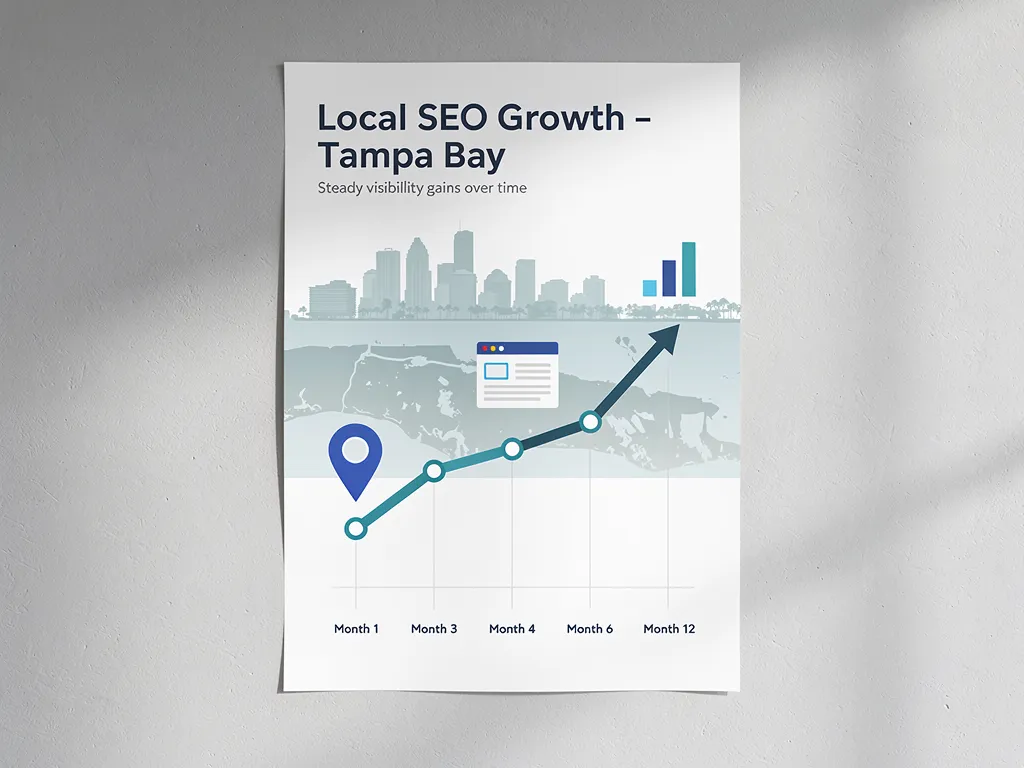
Most Tampa Bay businesses see early local SEO results in 3 to 6 months and steady lead growth in 6 to 12 months. Google Maps rankings often improve first, sometimes within weeks of optimizing a Google Business Profile. Competitive industries like personal injury law and brand-new websites typically need 12 months or longer to reach page one.
Key takeaways
- Google Business Profile fixes are the fastest win; organic rankings for service pages take longer.
- Competition, website age, and existing reviews matter more to speed than budget alone.
- Calls and booked appointments from search are the best proof that SEO is working.
- Results compound: work done in months 1 to 6 keeps paying off in year two and beyond.
What happens in each month of a local SEO campaign?
A typical local SEO campaign builds in stages. Months 1 to 2 fix the foundation, months 3 to 4 bring early ranking movement and Google Maps gains, months 5 to 6 produce measurable traffic growth, and months 7 to 12 turn that visibility into a consistent flow of calls, forms, and booked appointments.
Patience is built into how Google ranks pages. An Ahrefs study of how long it takes to rank found that only about 1.74% of newly published pages reach the top 10 within a year, and most top-10 pages are more than three years old.
| Timeframe | Work being done | What you should expect to see |
|---|---|---|
| Month 1 | Audit, keyword research, Google Business Profile cleanup, tracking setup | Baseline report; no ranking change yet |
| Month 2 | Technical fixes, on-page optimization, citation cleanup | Pages indexed correctly; small ranking shifts for branded terms |
| Months 3–4 | New service and location pages, review generation, first local links | Google Maps visibility improves; low-competition keywords begin ranking |
| Months 5–6 | Ongoing content, link building, profile posts and photos | Measurable organic traffic growth; first consistent organic calls and forms |
| Months 7–12 | Expanding content into more services and cities, refining top pages | Page-one rankings for core terms in less competitive markets; steady lead flow |
| Year 2 and beyond | Defending rankings, expanding to new keywords, refreshing older content | Compounding traffic and lower cost per lead |
How long does local SEO take by industry in Tampa Bay?
SEO timelines in Tampa Bay vary mainly by how competitive each industry is. General contractors and med spas often see results fastest, healthcare and dental practices fall in the middle, and law firms, especially personal injury firms, typically need the longest runway because so many well-funded firms compete for the same searches.
| Industry | Early movement | Consistent leads | Why |
|---|---|---|---|
| General contractors | 2–4 months | 5–9 months | Fewer firms invest heavily in SEO; service-area pages rank quickly in Pasco and eastern Hillsborough |
| Med spas | 3–4 months | 6–9 months | Treatment-specific searches, like “Botox St. Petersburg,” are less contested than broad terms |
| Healthcare practices | 3–5 months | 6–12 months | Hospital systems dominate broad terms; specialty and location pages win sooner |
| Dental offices | 3–5 months | 6–12 months | Many practices compete in Hyde Park, Carrollwood, and St. Petersburg; implant terms take longest |
| Attorneys | 4–6 months | 9–18 months | Personal injury, criminal defense, and family law terms are among the most competitive in Tampa |
These timelines assume consistent monthly work on an established website. A brand-new domain usually adds 2 to 4 months. Learn more about industry budgets in our Tampa Bay SEO cost guide.
What affects how fast local SEO works?

Six factors decide how fast local SEO produces results in Tampa Bay: competition in your industry, your website’s age and authority, your Google Business Profile’s condition, your review count and rating, how close you are to the searcher, and how consistently SEO work is done each month.
Does my website’s age matter?
Yes. Older websites with a history of quality content and links usually rank faster than new ones. A dental practice whose site has been live for ten years starts with built-in trust, while a brand-new domain for a med spa opening in Westchase has to earn that trust from scratch.
How much do reviews affect the timeline?
Reviews are one of the strongest Google Maps ranking signals. Businesses with steady, recent reviews climb the local map results faster. A contractor with 15 reviews competing against firms with 200 should expect a longer climb unless it builds a consistent review request process.
Why does location matter for Google Maps rankings?
Google weighs how close a business is to the person searching. A law firm in downtown Tampa will rank more easily for searchers nearby than for someone in Wesley Chapel. Location pages and service-area content help, but proximity limits how far Maps rankings can reach.
What other factors slow results down?
- Technical problems: Slow load times, indexing errors, or a recent site migration without redirects.
- Inconsistent business information: Different addresses or phone numbers across directories and your Sunbiz record.
- Thin content: One generic services page instead of a page for each service and city.
- Stop-and-start effort: Pausing SEO for a few months often erases early gains.
- Google algorithm updates: Core updates can shift rankings temporarily for an entire industry.
What is the standard local SEO process, and when does each step pay off?
The standard local SEO process has six steps, and each pays off on a different schedule. Google Business Profile and citation work pays off within weeks, technical and on-page fixes within one to three months, and content, links, and reviews compound over six to twelve months and beyond.
| Step | What it involves | When it typically pays off |
|---|---|---|
| 1. Audit and tracking setup | Review the site, rankings, and competitors; set up Google Analytics 4, Search Console, and call tracking | Immediately, as a baseline for measuring progress |
| 2. Google Business Profile optimization | Correct categories, services, hours, photos, and description | 2–8 weeks |
| 3. Citation cleanup | Match your name, address, and phone across directories | 1–3 months |
| 4. Technical and on-page fixes | Improve speed, fix errors, optimize titles, add schema markup | 1–3 months |
| 5. Content creation | Publish service, location, and question-based pages for Tampa Bay searches | 3‒9 months |
| 6. Reviews and local links | Build a review request process and earn links from local organizations | 3–12 months, compounding |
Why do Google Maps rankings improve faster than website rankings?
Google Maps rankings usually improve faster because they depend heavily on your Google Business Profile, reviews, and proximity, which can be improved quickly. Organic website rankings depend on content depth and links built over time, so they respond more slowly but deliver traffic from a much wider area.
For most Tampa Bay service businesses, both matter. The Map Pack captures urgent, nearby searches like “emergency dentist near me,” while organic pages capture research searches like “how much do dental implants cost in Tampa.”
Can you speed up local SEO results?
You can speed up local SEO by fixing your Google Business Profile first, building a steady review process, creating a dedicated page for every core service and city, and fixing technical problems early. Paid search can fill the gap while SEO builds, but no legitimate method guarantees instant rankings.
The fastest practical moves for a Tampa Bay business:
- Complete every field in your Google Business Profile and add new photos monthly.
- Ask every satisfied customer for a review, using a short link sent by text.
- Build separate pages for your top services and each city you serve, such as Tampa, Clearwater, or Brandon.
- Fix site speed and mobile issues, and if you are planning a new website, build SEO structure in from the start.
- Run Google Ads or Local Services Ads during the first months to generate leads while organic rankings grow.
What are the warning signs that SEO is not working?
SEO may not be working if rankings, traffic, and leads show no upward trend after six months of consistent effort, or if your agency cannot explain what was done each month. Flat results can come from the wrong keywords, weak content, technical problems, or work that was never actually performed.
Red flags to watch for:
- Reports show only rankings for keywords no customer would search
- No new pages or content published in months
- No growth in Google Business Profile calls or direction requests
- Promises of guaranteed first-page rankings in 30 days
- You do not have access to your own analytics or Search Console
How do you measure local SEO progress month to month?
Measure local SEO progress by tracking leads first and rankings second. The most useful monthly numbers are organic calls and form submissions, Google Business Profile actions, rankings for your core service terms in each city, and organic traffic to service pages. Leads prove return; rankings show direction.
| Metric | What healthy progress looks like | Where to find it |
|---|---|---|
| Organic calls and forms | Rising trend by months 5–6 | Call tracking and form analytics |
| Google Business Profile actions | Calls and direction requests rising by months 2–4 | Google Business Profile performance report |
| Local keyword rankings | Steady climb toward page one for core terms | Rank tracking tool |
| Organic traffic to service pages | Month-over-month growth by months 4–6 | Google Analytics 4 |
| Search impressions | Early rise in months 2–3, before clicks grow | Google Search Console |
Want a realistic timeline for your business? Request a free Tampa Bay SEO assessment and get a forecast based on your industry, competitors, and current website. Learn more about P3’s local SEO services in Tampa.